Cleaning in the Age of Real-Time Data
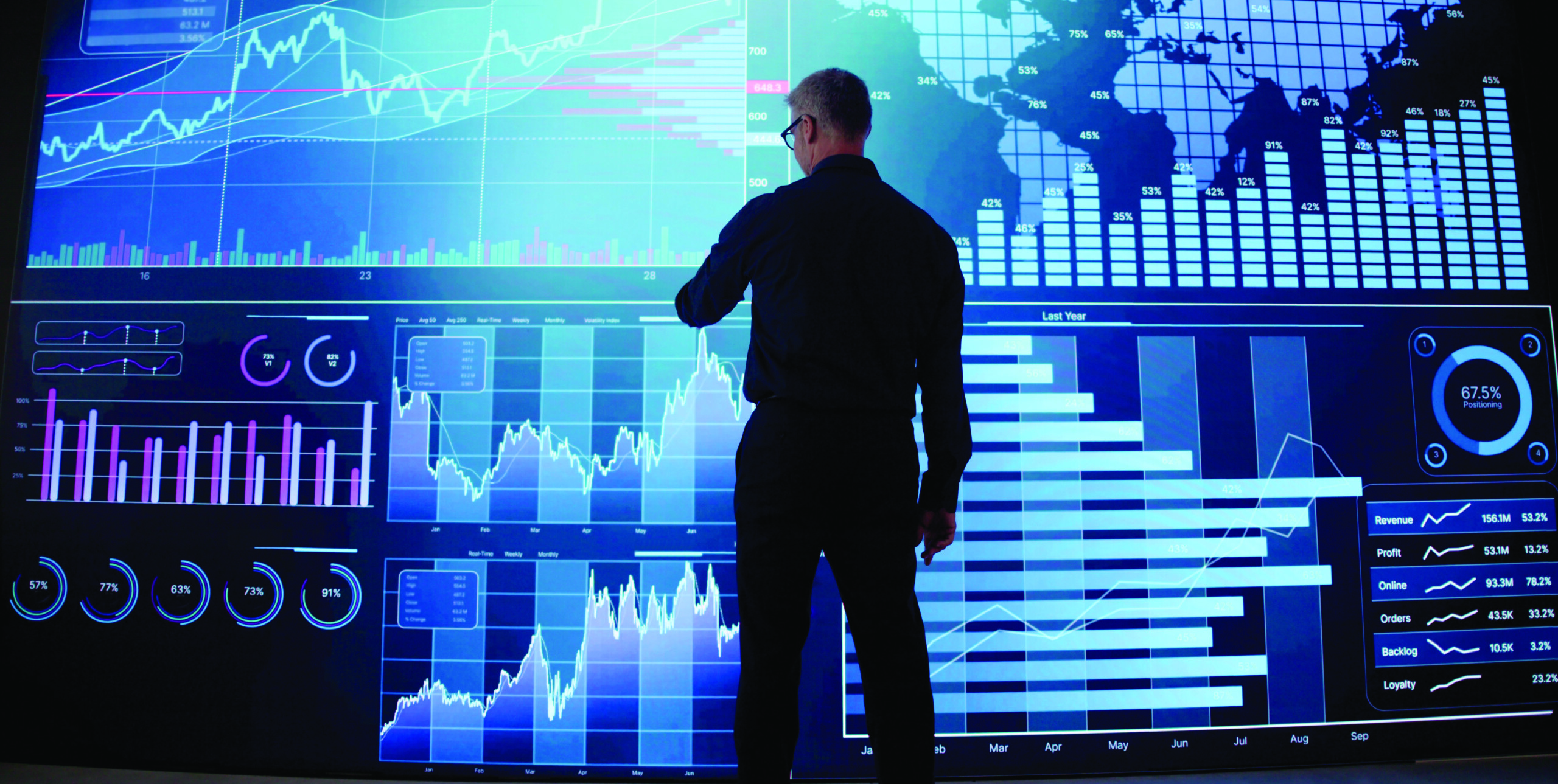
From smart dispensers and connected equipment to occupancy sensors and predictive maintenance, the Internet of Things (IoT) is transforming cleaning from a reactive task into a data-driven operation.
Real-time insights help facility managers optimize labor, improve service quality, reduce waste, and respond to issues before they become complaints. As connected technologies become more accessible, cleaning professionals are discovering how data can drive smarter decisions, greater efficiency, and better outcomes across every facility.
IoT defined
Broadly, IoT can be described as a network of physical objects, or “things,” that are embedded with sensors, software, and other technologies to connect and exchange data with other devices and systems over the Internet. IoT connects this network of objects with people who are responsible for managing specific aspects of a business.
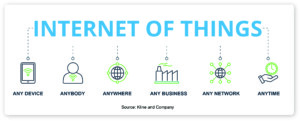
IoT is used for real-time data collection, analytics, problem-solving, and efficiency. It can mean different things to various users, depending on the context. For example, IoT can be used to help manage operations, including supply chain, logistics, and product delivery. In professional cleaning, IoT can be used to monitor chemical and water usage in dispensers, observe the health of crucial machines such as laundry and warewash machines, and indicate when it is time to refill paper/soap dispensers in the washroom.
Trends leading to IoT in professional cleaning
Cleaning and janitorial work is, for the most part, entry-level, low-wage employment that has led to a persistently diminished labor pool. Consequently, high turnover (~200%) and poor work quality are constant challenges.
The cleaning workforce is overrepresented by older workers (55% of janitorial staff in the United States are over 45 years old), and many younger workers who enter the field do so temporarily rather than as a career. Moreover, cleaning is performed during the second and third shifts, which increases absenteeism, turnover, and quality concerns. With rising labor costs and the challenges of finding and retaining employees, many building service contractors (BSCs) are finding that they need to offer higher wages than they offered previously.
How we benefit
Given the persistent issue of retaining labor and sufficient staff levels, there are several benefits for BSCs and contract cleaners using IoT, including:
- Increased productivity
- Enhanced cleanliness
- Focus on the safety of building users
- Efficient resource allocation
- Innovative brand perception
The janitorial business is becoming more commoditized and competitive; therefore, service companies are driving technological innovations to improve performance and the quality of cleaning outcomes, to differentiate themselves from other traditional companies.
- Robotics help commercial cleaning companies bridge the physical and digital gap, bringing performance management and analytics to real-world tasks.
- Conservative estimates based on a survey by Gallup indicate that the cost of replacing a single employee can range from one-half to two times the employee’s annual salary.
- Supporting cleaning staff with robotics could reduce physical strain and the monotony of cleaning tasks, potentially yielding significant savings.
- Workers’ safety and compensation claims are other reasons why robotics are replacing mundane tasks such as vacuuming, resulting in a strain on the back muscles and wrists.
End users’ perceptions of IoT
Most commonly adopted examples of IoT in commercial and institutional facilities are as follows:
- Intelligent hygiene, including IoT-enabled dispensers for paper towels, toilet paper, hand sanitizers, hand soaps, etc.
- Air care dispensers
- Smart warewash machines
- Smart laundry operations
- Robotic floor care.
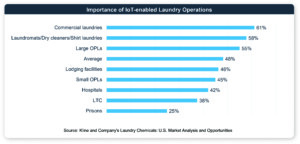
In a recent Kline survey of professional laundry decision-makers, respondents were asked to rate the importance of emerging trends in their operations, including technology-enabled efficiency and automation, such as IoT and smart/internet-enabled washing machines. This garnered strong ratings as extremely/very important for many respondents. On average, 48.2% of overall laundry respondents agreed. Commercial laundries, laundromats, and large on-premise laundries (OPLs) assigned higher importance levels than the average.
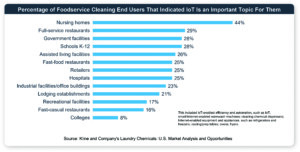
Another strong use case for IoT pertains to foodservice operations. In another recent Kline survey of professional end-use decision-makers on their foodservice operations, the following results emerged:
Challenges with IoT
Automation and IoT in professional cleaning operations come with real challenges that need to be addressed for the predicted strong growth of these systems to become a reality, including:
- Perceived costs
- Security of data collected and stored
- Compatibility with other systems, both legacy and new
- Privacy concerns of individuals being monitored/tracked
- Redefining roles and responsibilities and answering questions such as:
- Who owns the data?
- Who has access to the data?
- Who is responsible for making decisions based on the data?
- Does the manager have the time/resources to analyze the data to make use of IoT-connected devices?
- Proving a financial ROI to end users
The future of IoT in cleaning
There is widespread interest in automation and IoT among cleaning professional end users and consumers.
Over the past 10–15 years, robotics and IoT have been slowly and carefully adopted where a case for efficiency, reduced costs, and ROI could be made. The pandemic elevated professional cleaning as a crucial first line of defense against germs and spurred interest in using IoT to help keep buildings clean.
Currently, large, high-foot-traffic buildings and healthcare facilities employ automation and smart devices/sensors to help maintain facilities. With a greater focus on cleaning and hygiene, the prevalence of IoT and automation is expected to increase across facilities of various sizes over the next 5-10 years, as these technologies become more mainstream in industrial and institutional spaces.
Significant growth is expected to take place over the next 10 years as technology improves, increased demand drives prices down, and consumers begin to expect such state-of-the-art innovation in the buildings they use.
Professional cleaning chemical suppliers should align their product offerings to be compatible with IoT and automated cleaning robots in order to maintain relationships with key customer segments.