Visible Cleaning: Redefining Food Service Standards
In today’s food service environment, cleanliness is no longer judged solely by what happens behind the scenes. Today, it is defined by what guests see and experience. Visible cleaning, backed by simple, standardized practices, has emerged as a powerful driver of customer perception, trust, and ultimately, business performance.
This shift has been building for years but accelerated significantly in the wake of the pandemic. Today’s guests are more informed, more observant, and more apt to share their feelings (whether positive or negative). For operators, that means cleanliness has moved from an operational requirement to a far-reaching, brand-defining imperative.
The rise of visible cleaning: Perception is reality
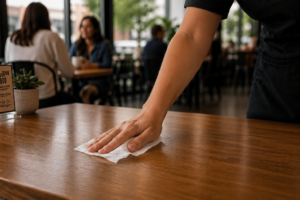
Cleanliness has always mattered, but now it directly influences where—and whether—customers choose to dine. According to recent research conducted by Datassential (Cleaning & Sanitizing, September 2024), 90% of consumers say cleanliness impacts their decision to eat at an establishment, and 84% say they prefer to see employees cleaning while they dine. These are clear signals that visibility is now an expectation, not a preference.
Visible cleaning serves as proof of perceived quality. Guests cannot audit back-of-house procedures, review sanitation logs, or verify compliance protocols. Instead, they rely on visual cues—wiped tables, clean restrooms, and consistent routines—to determine whether an environment is safe and well-managed.
This is where perception becomes reality. Even in a technically clean space, inconsistent or unclear practices can create doubt. A reused cloth, a missed surface, or an unaddressed spill can quickly undermine trust. In a world shaped by online reviews and social media, one visible lapse can outweigh dozens of positive experiences.
At the same time, expectations have evolved. The gold standard of cleanliness established in healthcare settings—where visible sanitization is routine—is now influencing food service. Guests have grown accustomed to seeing cleaning in hospitals, gyms, and grocery stores. They now expect that same level of transparency and rigor when dining out.
Where it matters most: High-visibility, high-touch areas
While all cleaning is important, not all areas carry equal weight in the customer’s eyes. Guests form impressions quickly, often within moments of entering a space, and those impressions are heavily influenced by what they can see and touch.
Front-of-house areas are especially critical. Tables, chairs, bar tops, and counters are immediate touchpoints. A sticky table or visibly unclean surface creates an instant negative reaction. Open kitchens and food preparation areas also play a growing role, as guests increasingly expect cleanliness to be maintained in real time.
Certain high-touch zones deserve particular attention:
- Condiment stations: Frequently overlooked, these areas are among the most prone to cross-contamination due to repeated handling and infrequent cleaning.
- Checkout and point of sale (POS) systems: Smudges and residue are highly visible on screens and surfaces, signaling neglect if not addressed regularly.
- Restrooms: Often viewed as a “trust test,” restroom cleanliness strongly influences overall perceptions of the establishment.
Ultimately, cleanliness in these visible, high-touch areas directly shapes customer behavior, impacting not only first impressions, but also how often guests return, and whether they return at all.
The balancing act: Simplicity drives consistency
For operators, the challenge lies in delivering visible, effective cleaning without disrupting service speed or workflow. The key is simplification.
Complex cleaning systems—those requiring multiple steps, measurements, or tools—introduce variability and increase the likelihood of inconsistency. When processes are difficult to follow, staff may skip steps or develop workarounds, leading to uneven results.
A simplified, standardized approach helps ensure:
- Consistency across shifts and locations
- Compliance with sanitation protocols
- Efficiency without slowing operations.
Equally important is ensuring that staff have what they need, where they need it, when they need it—and that they know how to use it. Reducing friction in the cleaning process increases the likelihood that it will be performed frequently and correctly.
Access matters: Cleaning in the moment
One of the most overlooked drivers of consistent cleaning is accessibility. If cleaning tools are stored separately from where they are needed, they are less likely to be used regularly.
Staging cleaning solutions within arm’s reach, at workstations, service areas, and high-traffic zones, enables staff to clean in the moment. This not only improves hygiene outcomes but also increases the visibility of cleaning actions, reinforcing customer confidence.
When cleaning becomes a seamless part of the workflow, it becomes more frequent, more consistent, and more visible.
Training for behavior, not just compliance
Even the best systems require effective training. Too often, training focuses on what needs to be done, rather than how to do it.
Driving behavioral change requires:
- Clear, simple instructions
- Visual and bilingual training materials to meet diverse workforce needs
- Step-by-step guidance using images or diagrams
- Verification, such as asking staff to demonstrate proper techniques.
Meeting staff where they are—and making training accessible and repeatable—ensures that cleaning practices are understood, adopted, and sustained over time.
From chore to competitive advantage
Perhaps the most significant shift is the role of cleaning as a brand differentiator.
Traditionally viewed as a back-of-house necessity, cleaning is now part of the guest experience. Visible cleaning signals professionalism, care, and operational discipline. It reassures guests that the environment is controlled and safe.
Consumers are not just noticing that cleaning is happening; they are evaluating how it is done. Research from Datassential (Cleaning & Sanitizing, September 2024) shows that 67% of consumers feel more confident in food safety when single-use disposable wipes are used instead of reusable cloths, and 78% prefer to see tables cleaned this way. This perception ties directly back to familiarity with healthcare standards, where single-use solutions are common.
The tools and methods used for cleaning have become part of the brand message. Guests interpret these signals as indicators of quality and trustworthiness.
Simplicity, consistency, and confidence
Simplified, ready-to-use cleaning approaches, like disposable wipes, can further enhance consistency and confidence. By eliminating the need for mixing or measuring, these solutions reduce variability and ensure the correct concentration is applied every time.
Regulatory guidance has evolved to reflect this shift. The U.S. Food and Drug Administration (FDA) now recognizes that when ready-to-use surface sanitizers are used according to their label instructions, additional testing to verify concentration is not required (FDA Food Code 2022). This reduces operational burden while supporting compliance.
For operators, the benefits are clear:
- Simplified processes drive operational efficiency
- Consistent results build trust
- Visible execution enhances the guest experience
Embedding cleanliness into brand culture
The most successful organizations treat cleaning and sanitizing not as a task, but as a core element of their culture. When integrated into onboarding, training, and daily operations, visible cleaning becomes second nature.
It also becomes a powerful storytelling tool. Guests may never see a checklist or audit report, but they will remember what they observed. Every visible cleaning action is an opportunity to reinforce brand trust.
In a competitive and economically challenging environment, this matters more than ever. By simplifying processes, improving access, investing in training, and embracing visibility, food service operators can turn cleaning into a strategic advantage. In doing so, they not only protect their operations but also strengthen their brand.
For more information on food safety and sanitation practices and resources, visit the Sani Professional website.