ISSA Leg. & Reg. Update – Advocacy in Action
 Welcome to the latest ISSA Legislative & Regulatory Update, a biweekly round up of the public policies currently impacting the cleaning and facility solutions industry. This update touches on a new video demonstrating how ISSA Advocacy impacts public policy important to the industry, ISSA submitting comments supporting DOL’s joint-employer proposal, ISSA Advocacy’s’ July 29 Bills & Spills reception in Chicago, and more.
Want to stay informed about critical government affairs impacting the entire built environment? Sign up here to have the ISSA Legislative & Regulatory Update emailed directly to you every other week.
ISSA Advocacy
See ISSA Advocacy in Action Advocacy works and ISSA proves it every day. Our new ISSA Advocacy video showcases how we advance policies that strengthen the cleaning and facility solutions industry, support workforce development, and promote innovation. From Capitol Hill to state capitals across the nation, ISSA ensures our industry’s voice is heard where decisions are made.
Watch the video to learn how ISSA Advocacy makes an impact and how you can expand that impact.
Support ISSA Advocacy to fuel the government affairs necessary to protect and advance the cleaning and facility solutions industry year-round.
 ISSA Submits Comments Supporting DOL’s Joint-Employer Proposal What it means: ISSA joined the Coalition for a Democratic Workplace and other organizations in supporting the U.S. Department of Labor’s (DOL) proposed rule to address joint-employer status under the Fair Labor Standards Act (FLSA), Family and Medical Leave Act (FMLA), and Migrant and Seasonal Agricultural Worker Protection Act (MSPA). The comments call on the department to adopt the proposed rule with minor modifications to enhance predictability and stability of the rule’s application:
“The Proposed Rule correctly recognizes that joint-employment liability is appropriate only in circumstances where a secondary business regularly directs or supervises the work of another employer’s employees on matters that are meaningful to the statutory rights addressed by the FLSA,
FMLA, and/or MSPA. Ordinary, arms-length contractual relationships between business partners should not open those partners up to costly lawsuits from another party’s employees. The four vertical joint-employment factors articulated by the Proposed Rule form the heart of the analysis to determine whether a business exercises sufficient control over employment conditions to merit redundant employment-law liability.” Why it matters: This DOL proposal could directly impact cleaning companies that rely on staffing agencies, subcontractors, franchise models, or vendor partnerships, including some building service contractors and residential cleaners. What ISSA is doing: Thank you to those ISSA member companies that submitted comments to ISSA regarding the proposed rule and informed our response to DOL’s proposal. View ISSA’s comments.
Chicago-Area Advocates: Join Us July 29 for Bills & Spills
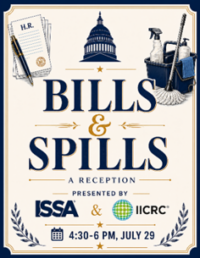 On July 29, ISSA and IICRC are hosting Bills & Spills, an exclusive networking reception in Chicago during the National Conference of State Legislatures Legislative Summit. From 4:30–6 pm at Miller’s Pub, you’ll have the opportunity to connect directly with state legislators and legislative staff from across the country while building relationships that can help advance the cleaning and restoration industries.
Why attend? Many of the policies affecting your business—from workforce development and facility management issues to PFAS and extended producer responsibility—are being debated and enacted in state capitals. Bills & Spills provides a relaxed setting to share your expertise, discuss industry challenges, and engage with policymakers before decisions are made.
Join us for drinks, appetizers, and meaningful conversations at one of Chicago’s iconic gathering spots. Space is limited. Register today and be part of the conversation shaping the future of our industry.
Free Webinar – Navigating Extended Producer Responsibility: Litigation Updates
 ISSA has partnered with the National Association of Wholesaler-Distributors (NAW) to update our members on the rapidly evolving extended producer responsibility (EPR) landscape and the opportunity for companies to actively engage in relevant litigation efforts.
Why attend? This free webinar from 1-2 pm CT on August 12 is designed for ISSA members tracking EPR legislation and evaluating whether to participate in coalition-based legal and policy efforts. NAW will provide a real-time update on the status of EPR litigation, what companies should expect next, and how interested members can join NAW’s broader coalition strategy. Register now
Thank you to ISSA member company Monahan Partners, Inc. for their recent contribution to the ISSA Advocacy Fund at the Promoter level.
Additional Updates
Supreme Court Permits Termination of TPS for Haiti & Syria: What Employers Should Know
On June 25, 2026, the U.S. Supreme Court ruled 6-3 in favor of the U.S. Department of Homeland Security’s (DHS) ability to terminate temporary protected status (TPS) for Haitian and Syrian nationals, reversing lower court orders to extend their status and work authorization. The court’s decision permits DHS to proceed with the termination of TPS for foreign nationals of Haiti and Syria, potentially impacting over 350,000 work-authorized individuals. Employers should review the impact of this decision on their employment-verification obligations. Learn more (JD Supra)
Regulatory
New Tariff Wave Could Replace Expiring Trade Duties by Late July
As importers continue navigating one of the most turbulent trade environments in recent memory, a new round of tariffs could arrive before existing duties disappear, potentially keeping pressure on global supply chains despite ongoing court challenges.
A new round of tariffs and policy moves could include proposed Section 301 tariffs tied to forced labor concerns, changes to Section 232 metal duties, uncertainty surrounding the future of USMCA negotiations, and continued litigation over tariffs imposed under the International Emergency Economic Powers Act. Learn more (Freight Waves)
- USTR announces non-renewal of USMCA (USTR)
- NLRB retreats on non-competes: what employers need to know (Lexology)
- TSCA mid-year update: what has happened, what to expect in 2026 & thereafter (JD Supra)
State & Local New
Eleven California Cities Just Raised Minimum Wages
Beginning July 1, workers in 11 California cities, including Fremont, Malibu, Milpitas, Pasadena, San Francisco, and Santa Monica, will earn local minimum wages that are higher than the state’s US$16.90 hourly minimum. Learn more (The Sacramento Bee)
- California first state to condition recyclability claims on achieving recyclability criteria (The National Law Review)
- Illinois poised to make significant changes to PFAS regulatory landscape (The National Law Review)