ISSA Leg. & Reg. Update – Federal Heat Standard Bill Advances
 Welcome to the latest ISSA Legislative & Regulatory Update, a biweekly round up of the public policies currently impacting the cleaning and facility solutions industry. This update touches on a heat standard bill advancing in Congress, the last chance to register for ISSA and IICRC’s July 29 Bills & Spills Reception in Chicago, a free webinar on litigation surrounding extended producer responsibility public policies, and more.
Want to stay informed about critical government affairs impacting the entire built environment? Sign up here to have the ISSA Legislative & Regulatory Update emailed directly to you every other week.
 House Committee Advances Bill Targeting Federal Heat Standard
What it means: On July 21, the U.S. House of Representatives Education and Workforce Committee voted 18-15 to advance the Heat Workforce Standards Act of 2025 (H.R. 6213). The legislation would prevent the Department of Labor (DOL) from moving forward with its proposed federal heat injury and illness prevention standard and would bar the agency from issuing or enforcing any substantially similar workplace heat regulations.
Why it matters: The committee vote marks the latest congressional action related to DOL’s ongoing heat rulemaking efforts. While H.R. 6213 has cleared the committee process, it must still be considered by the full House and advance through the legislative process before becoming law. A companion bill (S. 4427) was introduced in the Senate on April 29, 2026, by Senator Bill Cassidy (R-LA). If enacted, the legislation would effectively halt DOL’s current efforts to establish a federal heat standard.
What ISSA is doing: We will continue to monitor this legislation and provide updates as additional congressional action is scheduled. Learn more (Safety + Health)
 Last Chance to Register for Bills & Spills
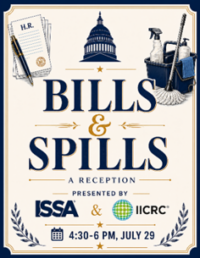
On July 29, join ISSA and IICRC for Bills & Spills, 4:30–6 pm at Chicago’s iconic Miller’s Pub—an exclusive networking reception during the National Conference of State Legislatures Legislative Summit, which attracts more than 1,500 state lawmakers and their staff from all 50 states. This is your opportunity to connect face-to-face with state legislators and legislative staff in a relaxed setting and ensure the cleaning and restoration industry’s voice is heard.
Why attend? From workforce development and facility management issues to PFAS and extended producer responsibility, the decisions made in state capitals directly affect your business. The best time to educate policymakers is before legislation moves forward.
Enjoy drinks, appetizers, and candid conversations while building relationships that can make a lasting impact for your company and our industry.
Space is limited, and time is running out. Register today—this is your last chance to be part of the conversation. Register now
Free Webinar: EPR Laws Are Expanding—Is Your Business Ready?
 Extended producer responsibility (EPR) laws are rapidly emerging as one of the most important state policy issues impacting the cleaning and facility solutions industry. With more states adopting packaging EPR laws and regulations each year, manufacturers and distributors need to understand what’s changing and what’s at stake.
Join ISSA and the National Association of Wholesaler-Distributors (NAW) for a FREE webinar, 1–2 pm CT on August 12, to explore the latest developments in the EPR landscape.
Why attend? You’ll gain practical insights on:
- The current EPR litigation landscape
- Why EPR is a growing concern for manufacturers, distributors, and other channel partners
- How NAW is leading legal challenges in key states
- What participation in NAW’s coalition efforts looks like
- And how cleaning companies can have a seat at the table as these cases develop
This is a timely opportunity to hear from industry experts, better understand the legal and regulatory landscape, and learn how your company can help shape the future of EPR policy.
Register now and stay ahead of one of the fastest-moving policy issues affecting our industry.
Additional Updates
Regulatory
Trump Imposes Broad New Tariffs on 60 Trade Partners
The Trump administration imposed new tariffs beginning July 24 on dozens of countries over alleged forced-labor violations. The duties, set between 10% and 12.5%, effectively replace President Trump’s temporary 10% global tariffs, which expired at the same time as the new ones took effect. The new tariffs apply to 60 trade partners and cover 99.4% of U.S. trade.
The new tariffs are being brought under Section 301 of the Trade Act of 1974, one of the trade tools Trump has wielded since the Supreme Court struck down his global “liberation day” duties on February 20. The tariffs do not “stack” on top of existing import taxes on steel and aluminum, known as Section 232 duties, that Trump imposed last year on national-security grounds. The White House also recently imposed 25% tariffs on most U.S. imports from Brazil, which took effect last week, and 50% tariffs on a wide range of goods from Canada under Section 338 of the 1930 Trade Act, which are set to begin next month. Learn more here (CNBC) and here (USTR)
Legislative
House Passes Stopgap Measure to Fund Federal Government
The U.S. House of Representatives passed, by a vote of 220 to 205, a stopgap measure that would fund federal agencies at existing levels through December 4 to avert a potential government shutdown before the end of the fiscal year on September 30. The legislation now moves to the Senate, where it will require bipartisan support to clear the 60-vote threshold needed for passage. Senate lawmakers are expected to negotiate changes before any final agreement can be sent to the President. Learn more (The Hill)
- American Franchise Act moves toward full House vote (Franchise Wire)
Judicial & State News
Federal Court Enjoins California’s SB 343 Recyclability Labeling Law
On July 14, a California federal court granted a preliminary injunction blocking the California Attorney General from enforcing Senate Bill 343, a law regulating recyclability claims on products and packaging.
SB 343 requires businesses to determine that their products meet recycling access, sorting, and design requirements, or else remove recyclability claims from products and packaging manufactured after October 4. In its decision, the court ruled that plaintiffs, a coalition of trade associations, were likely to succeed in their claims that the law is unconstitutionally vague and violates the First Amendment. Learn more (The National Law Review)
Five Packaging EPR Lawsuits to Watch
In the last year, business groups, manufacturers, environmental groups, and state attorneys general have all filed an array of lawsuits challenging new state extended producer responsibility (EPR) for packaging laws. None of the cases have yet been resolved, but their outcomes are poised to influence how states consider or write EPR policies. Learn more (Packaging Dive)
Join our free webinar Navigating EPR: Litigation Updates from NAW on August 12 to learn more about EPR litigation and how your company can participate in relevant coalition-based legal and policy efforts. Register now