FIFA World Cup 2026 and Cleaning for Performance

When the FIFA World Cup 2026TM begins on June 11, 2026, the world will be watching. All eyes will be on the teams, and success is measured in goals. But the success of the tournament will hinge equally on something less visible: The cleaning and environmental hygiene systems that protect athlete performance, fan safety, and venue continuity.
With 48 national teams, 104 matches, an anticipated five million spectators, and 16 stadiums across the United States, Canada, and Mexico, no detail can be left to chance. In large-scale events, cleaning is no longer about appearance; success will be measured in cleanliness, safety, resilience, and athletic performance science.
Mass-gathering events are complex systems that bring together high-density crowds in enclosed spaces, where risks related to infectious disease transmission, surface contamination, indoor air quality (IAQ), and waste management can escalate rapidly if not properly managed. Research from the World Health Organization (WHO) defines mass gatherings as environments that require “distinctive planning, communication, and risk-management strategies due to the concentration of people and increased public health risks.” At the FIFA World Cup or Olympic Games, cleaning is not housekeeping; it is public health infrastructure, critical to athlete performance and fan experience.
Performance depends on clean environments
Elite athletes depend on controlled environments that support respiratory function, neurological processing, hydration, and recovery to perform at their highest level. Poor IAQ and contaminated surfaces are invisible threats that can degrade high-performance capacity. This includes the cleanliness of locker rooms, training facilities, physiotherapy spaces, hydration stations, restrooms, team hotels, and transportation environments (buses, planes, tunnels, walkways).
Studies confirm that viral particles, molds, allergens, and bacterial pathogens persist on surfaces and soft furnishings in indoor sports environments and can be resuspended into the air by foot traffic and other activity. This reintroduces exposure risk. Evidence also shows that IAQ affects reaction time, precision, cognitive processing, hydration responses, and cardiovascular and respiratory function, all of which directly influence athletic performance.
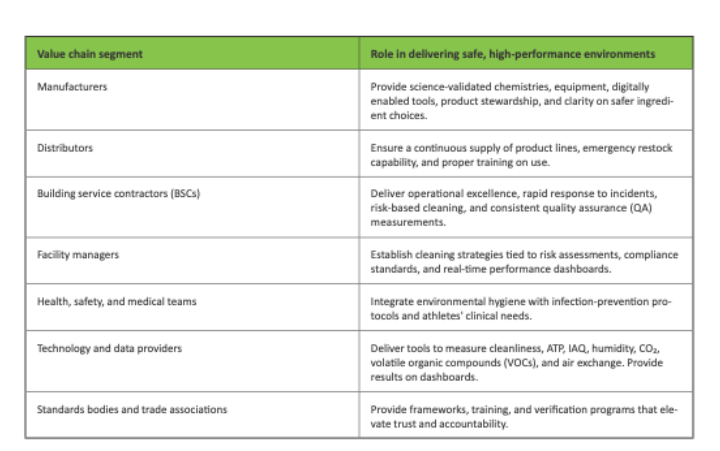
Cleaning for performance means cleaning strategically, not harder, but smarter. This requires evidence-based decision-making, standardized measurement, and clear alignment across the cleaning value chain.
Winning the World Cup requires a coordinated team, and so does winning environmental control of the built environment.
Risk-based cleaning for elite competition
Cleaning for the FIFA World Cup must be driven by risk assessment and science, not appearance. The U.S. Centers for Disease Control and Prevention recommends risk-based environmental hygiene strategies for high-density environments, with increased focus on ventilation, surface testing, and targeted disinfection.
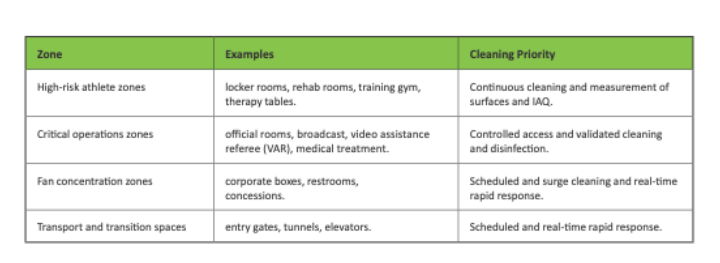
A comprehensive event-hygiene plan should include:
- Define risk zones (use a floor plan)
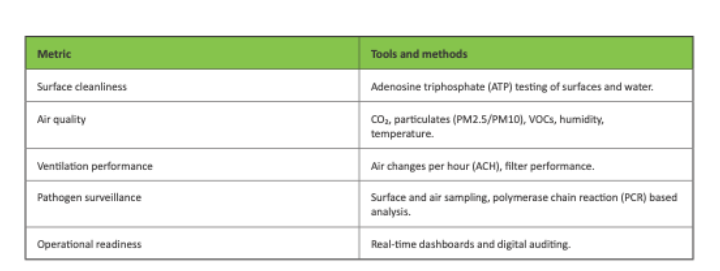
- Measure cleanliness to validate performance
Visible cleanliness is not evidence for health and safety. Cleaning without measurement is guessing, and guessing is not a strategy. Measurement tools that matter:
- Ventilation and IAQ as performance infrastructure
Improving and maintaining IAQ must be managed as a controllable performance asset. For athletes, ventilation is one of the most powerful tools we have. If we control air movement, then we can control infection risk. Understanding IAQ leads to better performance.
Key IAQ strategies include some of the following:
- Monitor indoor air quality.
- Increase ventilation and air exchanges during occupancy surges.
- Use HEPA or minimum efficiency reporting value (MERV)13 filtration.
- Control humidity 40-60% to reduce pathogen survival.
- Use portable air cleaning systems in locker rooms and training gyms.
- Chemical products and safer choices
Cleaning products and disinfectants are critical tools, but overuse or misuse can increase the risk of respiratory irritation, asthma triggers, skin damage, and reduced immune function, which can affect an athlete’s performance. Selecting products with safer, certified chemistries, such as the U.S. Environmental Protection Agency’s (EPA’s) Safer Choice, Green Seal, or UL ECOLOGO®, reduces exposure to potentially harmful ingredients while maintaining cleaning efficacy.
Making safer choices means:
- Choose products with transparent ingredient data.
- Match chemistry to risk and surface.
- Reduce fragrance-heavy formulations that burden respiratory health. Use an IAQ monitor to measure VOCs.
- Use automated dosing and dilution devices to prevent concentration errors.
Front-line workers: The real difference makers
The most advanced cleaning strategy will fail without a trained and respected workforce. Studies show that training and competency validation directly improve cleaning outcomes and significantly reduce the transmission of infections. Workers must be equipped with:
- Fit-for-purpose personal protective equipment (PPE) and ergonomic tools.
- Standard operating procedures (SOPs) based on workflow sequencing and validation.
- Incident response and hazardous cleanup training.
- Authority to report failures and trigger action.
Front-line workers have many names: janitors, custodians, cleaners, and housekeepers. But they function as health protection professionals.
Winning on the world stage
A safe and successful FIFA World Cup requires preparation, measurement, adaptation, and relentless consistency.
When cleaning is evidence-based:
- Athletes stay healthy, recover faster, and perform better.
- Staff illness and absenteeism decrease.
- Fan confidence strengthens.
- Media narratives remain positive.
- Operational continuity is protected.
- Sustainability and chemical footprint improve.
To be successful, the cleaning industry strategy for the FIFA World Cup must operate like a championship team.
Winning on the scoreboard = winning operational excellence
The FIFA World Cup 2026 is a huge sporting event. The world is coming. The referee whistles will blow. The stadium lights will shine. This is the cleaning industry’s moment to deliver victory.
Share your stories with ISSA’s Making Safer Choices Community of Practice at issa.com/making-safer-choices.
References
World Health Organization. Public Health for Mass Gatherings: Key Considerations. WHO, 2015.
Allen JG & Macomber JD. Healthy Buildings: How Indoor Spaces Drive Performance and Productivity. Harvard University Press, 2020.
Heintz EC, et al. Air Quality is Predictive of Mistakes in Professional Baseball and American Football. International Journal of Environmental Research and Public Health. Vol 20(1):542. 29 Dec 2022.
Zacharko M., et al. Air Pollutants Reduce the Physical Activity of Professional Soccer Players. International Journal of Environmental Research and Public Health. Vol 18(24):12928. 8 Dec. 2021.