Sustainability Trends

Most foodservice operators indicate that sustainability initiatives are becoming increasingly prevalent at their establishments. Many restaurants and institutional kitchens are focused on food waste reduction, sustainable and local sourcing of ingredients, and energy-efficient, smart kitchens as part of these initiatives.
However, using sustainable cleaning products and procedures has also become a key focus of industrial and institutional kitchens. They are prioritizing eco-friendly practices to enhance food safety, positively impact the environment, and maintain compliance with food safety and environmental regulations. They are incorporating sustainability into all aspects of cleaning and facility solutions management, with sustainability goals through 2030, including Leadership in Energy and Environmental Design (LEED) certification and participation in the EPA’s Energy Star® and Safer Choice programs.
This article examines the spectrum of sustainability and how these trends impact professional kitchens. Below are excerpts of survey results from recent research conducted by Kline with 750 professional decision-makers at foodservice and commercial kitchens.
Sustainability survey results in professional foodservice
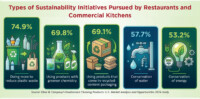
According to this research, 43% of the surveyed end users stated that using green cleaning products was highly valuable and a top priority for them. When asked about the state of sustainability initiatives at their facilities, the vast majority (89.7%) stated that these initiatives are growing. When asked about the types of initiatives being implemented to enhance sustainability, most respondents mentioned their efforts to reduce plastic waste, using products with greener chemistries, and utilizing products packaged in recycled-content materials. Other sustainability strategies making an impact included a focus on strategies to conserve water and energy.
These business owners and decision-makers are also willing to put their money where their mouths are, so to speak, with 89.7% indicating a willingness to pay more for green food service cleaning products. Nearly one-third of respondents cited their willingness to pay 1%–10% more for green cleaning products. Another quarter also stated they were willing to pay 11%–20% more for green cleaning products. On average, end users cited their willingness to pay much more for green cleaning products than traditional cleaning chemicals.
However, when it comes to the most important factors considered when making buying decisions, effectiveness, safety, cost, and convenience tend to be weighed more heavily than sustainability. When asked about the importance of sustainability in cleaning products they use, only 42.8% rated “environmental friendliness and green/sustainable ingredients” as the most important consideration when determining which products to buy. And 39.3% viewed the “product supports efforts to reduce our carbon footprint” as a factor that is most important when making purchase decisions.
Regulations for restaurants
In the United States, several authorities, including the U.S. Food and Drug Administration (FDA), Occupational Safety and Health Administration (OSHA), and the Centers for Disease Control and Prevention (CDC), collaborate to ensure that food is safe for consumption from farm to table and to prevent foodborne illnesses.
Additionally, third-party auditors like the National Sanitation Foundation (NSF) are becoming increasingly popular among foodservice establishments, helping them meet regulations set by the FDA and other federal agencies.
The Food Safety Modernization Act (FSMA), first introduced in 2011 and established by the FDA, aims to enhance traceability in the food supply chain and includes a rule that places additional responsibilities on all stakeholders within the supply chain, including food retailers and food service establishments, which handle certain high-risk foods. The FSMA rule is fully in effect as of March 2026 for restaurants and commercial kitchens, and compliance will help prevent foodborne illness outbreaks by enabling the quick identification and removal of contaminated products. Generally, the FSMA already requires food establishments to implement effective sanitation programs to comply with the law.
 Additionally, commercial kitchens are required to have Hazard Analysis Critical Control Point (HACCP) systems in place to ensure food safety by identifying and controlling hazards. The FDA also mandates that commercial kitchens have adequate handwashing facilities, always equipped with soap and hand-drying options. The safest option is to equip these areas with touch-free appliances to minimize cross-contamination.
Cleaning and sanitation are also crucial, requiring kitchens to clean and sanitize all surfaces and equipment used for food preparation, including countertops, cutting boards, utensils, and kitchen appliances. OSHA is the federal agency that restaurateurs must work with when designing and operating a restaurant kitchen. Regular surface cleaning and ensuring employee access to handwashing facilities are among the general practices outlined by OSHA.
Energy usage
Foodservice remains one of the most energy-intensive commercial sectors.
Commercial kitchens consume significantly more energy per square foot than other retail spaces, with HVAC (heating, ventilation, and air conditioning), refrigeration, and cooking equipment accounting for most energy use.
Upgrading to ENERGY STAR–rated equipment, demand-controlled ventilation, and LED lighting can reduce energy use by 10–30% or more. In practice, these efforts may involve energy management systems (EMS) integrating HVAC, refrigeration, and cooking equipment; induction cooking and high-efficiency fryers; predictive maintenance using IoT sensors; and/or solar and renewable energy pilots at multi-unit operators.
Packaging trends
For restaurants, the form in which take-away food is packaged is highly visible to consumers, and most consumers view recyclability as an important packaging sustainability factor.
Single-use plastics are increasingly restricted by state and local regulations, nudging operators toward compostable, fiber-based, or reusable packaging alternatives. Foodservice operators are also reducing secondary packaging, using reusable packaging pilots for delivery and catering, and better packaging data tracking tied to environmental, social, and governance (ESG) reporting.
Foodservice manufacturing company Supreme Source & Supply, maker of Nature’s Source products, offers carbon footprint tracing technology. This technology enables food service operators to monitor their packaging carbon footprint in real time and make swaps (using Nature’s Source products or others) to packaging that is less harsh on the environment.
Through vertical integration in its supply chain, the company uses data to trace packaging manufacturing back to the raw materials, then gathers data on how the packaging is made, and finally on how it is transported. The data is then all independently verified and certified by an external global accreditation company.
Sustainability in foodservice cleaning has many facets
Chemicals: Foodservice operators are increasingly transitioning to safer, more sustainable cleaning chemicals. They are shifting away from traditional high-VOC (volatile organic compound), high-toxicity cleaners and making greater use of EPA Safer Choice–certified cleaners, biodegradable surfactants, and low-VOC formulations.
These restaurants are opting for neutral or enzyme-based floor and surface cleaners, concentrated cleaners diluted on-site (less packaging, lower carbon footprint), and green certifications used in chain-wide specifications. There is also reduced reliance on chlorine-heavy and solvent-intensive cleaners, where the food code allows. The benefits of these changes include improved indoor air quality (IAQ) for staff and guests, reduced worker exposure and training burden, and support for ESG and corporate sustainability commitments.
Dilution and dispensing systems: Chemical overuse has long been a hidden cost and waste driver for foodservice operators. As a result, there is broader adoption of closed-loop dispensing systems to control dilution accuracy, which means a transition from ready-to-use products to high-concentrate formats. There are several reasons for these systems. They prevent overdosing (cost + environmental impact), significantly cut packaging waste, and improve compliance with food and worker safety standards.
Water conservation in cleaning and sanitation: Water use is increasingly scrutinized, especially in high-volume kitchens. To combat water waste, restaurants are installing low-flow pre-rinse spray valves that can cut water use by up to 20–60%, efficient dish machines that reduce both water and energy per rack, and water-smart mop systems.
They are also training staff to eliminate continuous water flow during cleaning. Warewashing and floor cleaning are major water-use hotspots; water conservation reduces sewer fees and operating costs and supports local water-efficiency regulations.
Towels, wipes, and paper reduction: Single-use cleaning materials are also under increased sustainability review, including disposable wipes. Some foodservice operators are replacing disposable wipes with reusable microfiber systems and employing color-coded microfiber programs to reduce cross-contamination. Microfibers require less chemical use and water to achieve cleanliness, reduce landfill waste, and extend product life, lowering the cost per use.
Some operators are also reducing paper towel use outside critical hygiene points or opting for cleaning wipes with better degradability, such as those made from cotton, bamboo, or wood pulp fibers.
Industry support: Foodservice operators have several places to turn for industry support when it comes to sustainability, including the National Restaurant Association and EPA programs that promote best practices. ISSA educational and outreach programs are a trusted source for operators. And many cleaning products suppliers offer training, innovative products, and programs that integrate sustainability into food safety and operational training.
Sustainability is no longer optional for U.S. foodservice operators. It is necessary because sustainability is:
- A cost-control strategy (food, energy, and water savings).
- A consumer expectation (especially with younger demographics).
- A regulatory and supply-chain requirement.
- A means for labor and safety improvements.
- An ESG and brand reputation driver.
- A source of competitive differentiation.
There are multiple sustainability initiatives that foodservice professionals need to consider and adopt as part of their day-to-day business. Making it a key focus in our foodservice business, or any business, should be a priority.